
How PCOS Can Change Your Body, Your Pain, and Your Posture
What if it is more than just hormones?
Most people think of PCOS as a “hormone” or “fertility” problem — something that affects periods, ovaries, and maybe weight. But growing research shows that PCOS doesn’t just live in your ovaries. It lives in your whole body. It can quietly change how you move, how you feel, and even how your posture lines up.
If you’ve ever wondered why your neck feels tight, your back aches more than it used to, your hips feel stiff, or your body just “feels heavier” than before, you’re not imagining it. PCOS can affect your muscles, your joints, and the way you hold yourself — and science is starting to back up what many women already feel.
1: PCOS and Pain — It’s Not Just “in Your Pelvis”
One major review looked at how women with PCOS report pain and overall quality of life compared with women without PCOS.¹ This study pooled data from several large health surveys and found a clear pattern:
Women with PCOS reported more bodily pain and lower quality of life than women without PCOS.¹
The pain is often widespread — not just pelvic or menstrual — and can involve shoulders, neck, lower back, hips, and legs.¹
The more metabolic and hormonal issues a woman has (like weight gain, trouble with ovulation, or mood changes), the more likely she is to report higher pain and reduced well‑being.¹
In simple terms, this means that PCOS pain is real, measurable, and body‑wide. It’s not just “in your head.” If you feel like you’re sore all over, tired, and stiff, PCOS can be part of that story.¹
2: How PCOS Makes Your Muscles Feel “Heavy” and Tired
Another paper explored what’s happening inside the muscles of women with PCOS.² It showed that PCOS is not just a “hormone issue” — it’s also a metabolic and muscle‑level issue.
Key points in plain language:
In women with PCOS, muscle cells are less efficient at using glucose from the blood, even when they are not overweight.²
This makes it harder for muscles to get the energy they need, which can lead to fatigue, stiffness, and a “heavy” feeling in the body.²
The energy‑producing parts of your cells (mitochondria) are often smaller and less active in PCOS, so your body has to work harder for the same amount of movement.²
At the same time, PCOS tends to create chronic low‑grade inflammation and abnormal fat‑hormone signals, which can make your body more sensitive to pain.²
If you’ve ever said, “My legs feel like concrete,” or “I feel so tired even when I haven’t done much,” this paper helps explain why PCOS can make your muscles feel that way.²
3: PCOS and Your Posture — Pelvis, Back, and How You Stand
A third study looked at how women with PCOS stand and move compared with women without PCOS.³ It’s a case‑control study, which means the researchers directly compared two groups.
What they found:
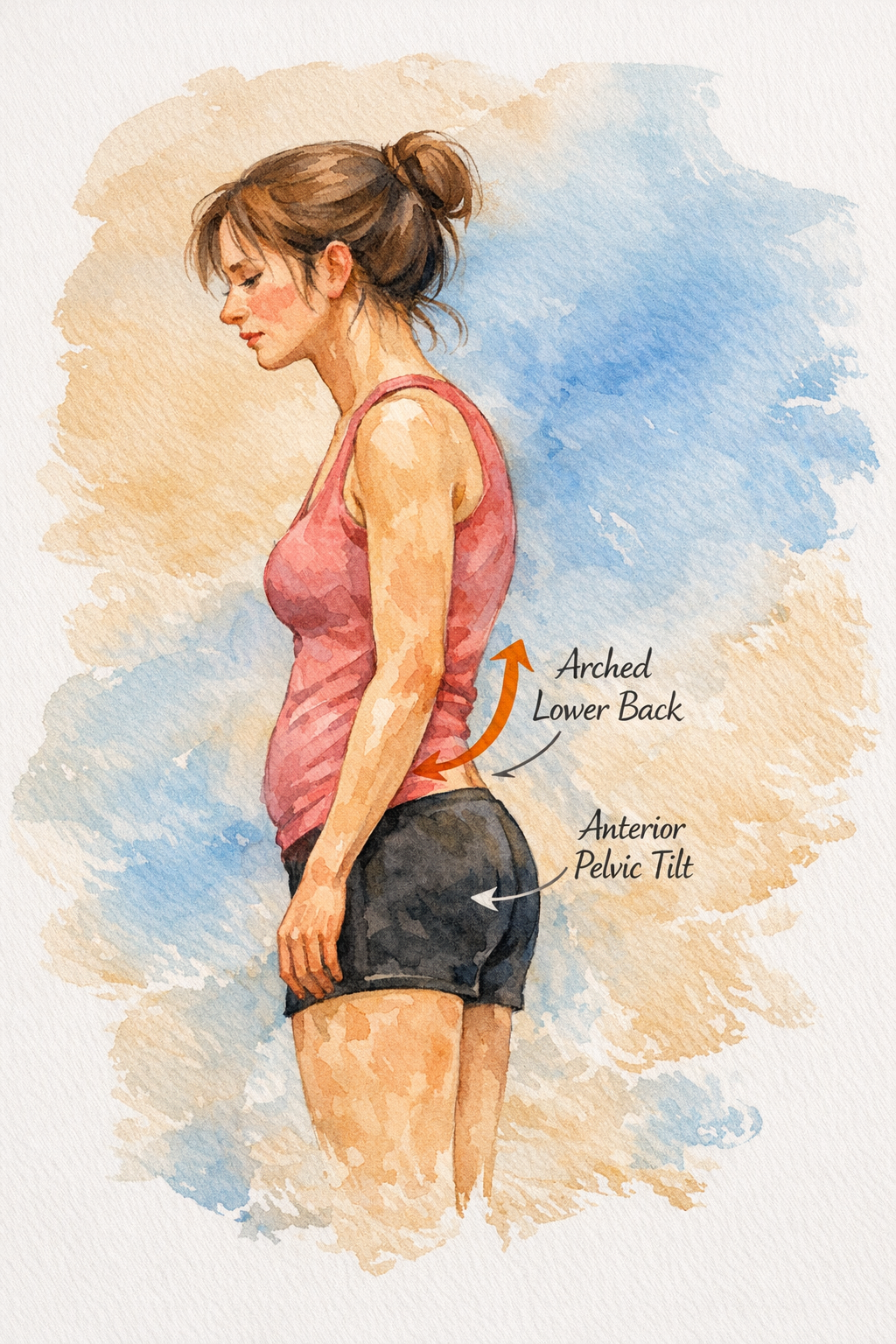
Women with PCOS tended to have a more forward‑tilted pelvis (the pelvis angles forward more).³
They also had a more curved lower back (a deeper lumbar lordosis).³
These posture changes were strongly linked with PCOS hormonal markers, suggesting that hormones are quietly shaping how the pelvis and back line up over time.³
This doesn’t mean that PCOS posture “causes” your pain all by itself. But it does mean that your body may be loading your hips, knees, and lower back differently than it used to. This can make certain movements feel more uncomfortable, especially when combined with fatigue and soreness.²,³
If you’ve noticed that your lower back looks “more curved,” your hips feel tight, or your posture has changed since your PCOS diagnosis, this research supports that your body really has shifted — and it’s not just in your imagination.³
What This Means for You
If you’re dealing with:
Fatigue, stiffness, or a “heavy” feeling in your body.
Back, hip, neck, or shoulder pain that seems to worsen over time.
A sense that your posture has changed — more forward‑tilted pelvis, more rounded back, or forward‑tilted head —
then PCOS can be part of the story, but it’s not the only piece.¹,²,³
Your body is dealing with:
Hormonal changes.
Changes in how your muscles and fat work.
Changes in how you stand and move.
None of this is permanent. Movement, posture work, strength training, and hands‑on care can all help your body function more efficiently and reduce how much pain and stiffness you feel.¹,²,³
How We Can Support You
If you’re someone with PCOS who feels tired, stiff, and “out of alignment,” a tailored approach can make a big difference. This might include:
Gentle adjustments and soft‑tissue work to help your joints and muscles move more easily.
Simple exercises and posture cues to help your body carry itself more comfortably.
Guidance on lifestyle habits that support better insulin sensitivity and lower inflammation, which can ease both metabolic and muscular strain.²,³
You don’t need to “fix everything at once.” You just need to start giving your body the right inputs — movement, support, and care — so it can gradually relearn how to feel lighter and move better.¹,²,³
References
Kazemi M, McBreairty LE, Chilibeck PD, Zello GA, et al. Evaluation of bodily pain associated with polycystic ovary syndrome: A review of health‑related quality of life and potential risk factors. J Obstet Gynaecol Can. 2022;44(2):144‑153. PMID: 36551953; PMCID: PMC9776021.
Characterizing skeletal muscle dysfunction in women with polycystic ovary syndrome: A review. Ther Adv Endocrinol Metab. 2022;13:1‑17. PMID: 35919527; PMCID: PMC9297442.
El‑Sayed WH, Mohamed AA, El‑Sayed AM. Biomechanical changes in females with polycystic ovarian syndrome: a case‑control study. Bull Fac Phys Ther. 2021;26(1):1‑8. PMID: 40169684; PMCID: PMC11961699.