
How Chiropractic Adjustments Help Your Brain and Body Work Better
What Does the Science Say?
How Chiropractic Adjustments Help Your Body and Brain
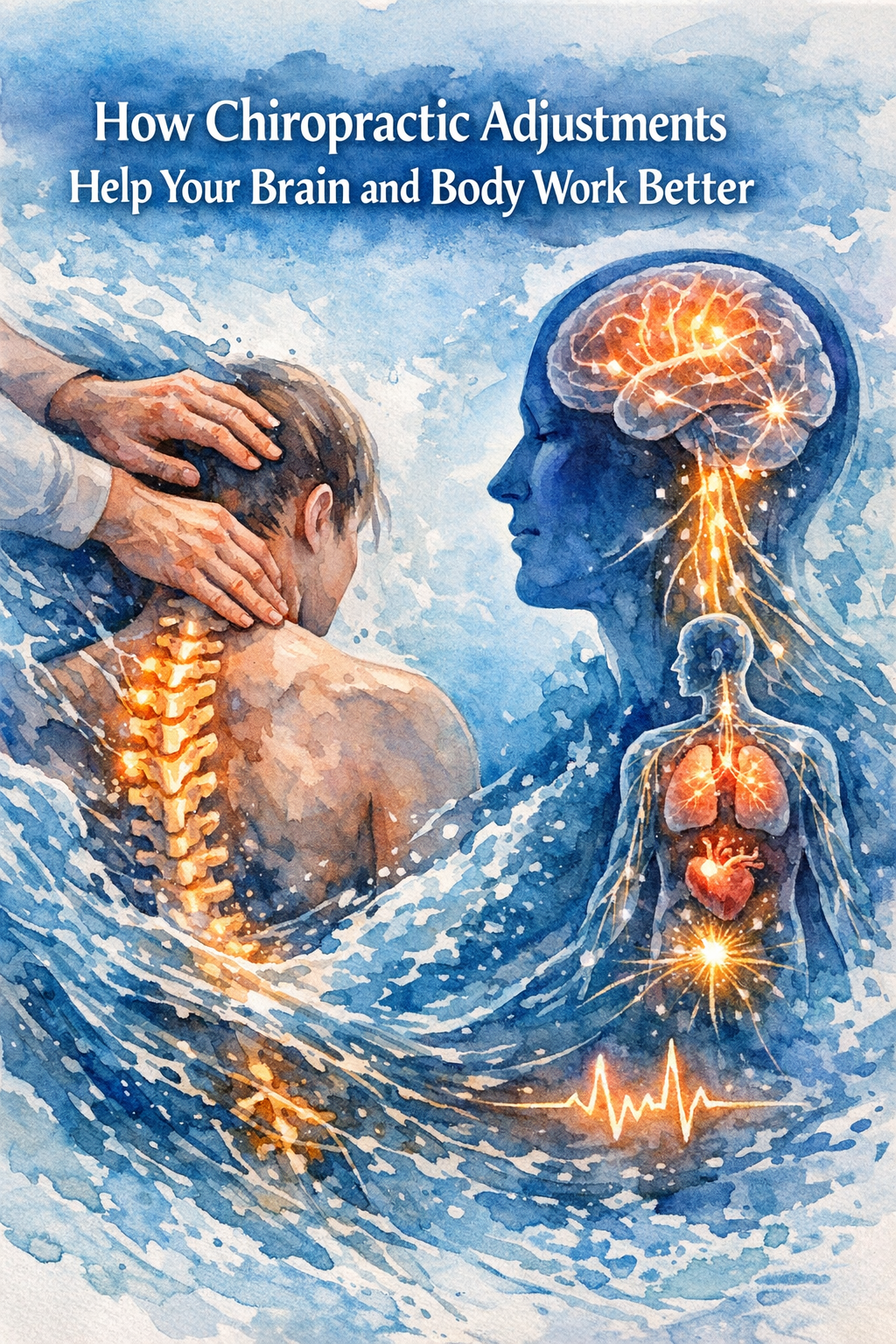
If you’ve ever had a chiropractic adjustment, it might have felt like a quick “pop” in your neck or back. But beneath that simple sensation, something much deeper is happening. Recent research shows that chiropractic care can influence not just your muscles and joints, but even the way your brain and nervous system communicate with your body.¹⁻³
Let’s break down what three key studies tell us — in plain language — and what this means for someone sitting in the waiting room with back pain, neck stiffness, or headaches.
1. Adjustments Change How Your Brain Processes Signals
One study looked at people with dysfunctional spinal joints (areas where movement is restricted or painful) and measured brain activity before and after a chiropractic joint manipulation.¹ Using advanced brain‑imaging techniques, the researchers found that after an adjustment, the prefrontal cortex — a part of the brain involved in coordination, awareness of movement, and decision‑making — changed how it processed signals from the spine.¹
In simple terms:
When a joint isn’t moving properly, the brain’s “map” of that area can become fuzzy.
Chiropractic adjustments appear to help “reset” that map, improving how your brain senses and controls movement.¹
2. How “Stuck” Joints Affect Muscle Control
A second paper explains a modern model of vertebral (spinal) joint dysfunction.² It describes how a restricted or irritated spinal joint can:
Disrupt nerve signals.
Change how muscles around the spine fire — sometimes making them too tight, too weak, or out of sync.²
When the body receives conflicting signals, your posture and movement patterns can become less efficient. This can contribute to:
Chronic back or neck pain.
Recurring stiffness or reduced range of motion.²
High‑velocity, low‑amplitude (HVLA) thrusts — the kind of safe, controlled adjustments used by chiropractors — have been shown to help restore more normal joint motion and neuromuscular function.² In other words, they can help “retune” the way your spine and muscles work together.
3. Helping Your Body Move Better After Pain or Injury
A third review focuses on sensorimotor integration — how your brain senses your body’s position (proprioception) and controls movement.³ After injury, pain, or long‑term stiffness, this system can become “disordered.” You might feel:
Less sure about your balance.
More awkward when twisting, bending, or lifting.
Like your body “doesn’t feel like itself” anymore.³
This paper explains that spinal manipulation can:
Improve joint motion and reduce irritation of nearby nerves.
Help restore more normal communication between your spine, muscles, and brain.
Support better coordination, balance, and movement control — especially in people recovering from back or neck pain.³
What These Studies Mean for You as a Patient
Taken together, these three pieces of research suggest that chiropractic care can provide more than just short‑term relief.¹⁻³ Here’s what that might look like for you:
Reduced pain and stiffness – Adjustments help free up restricted spinal joints, which can ease local discomfort.²⁻³
Better movement and coordination – By improving how your spine and nervous system communicate, your body can move more smoothly and efficiently.¹⁻³
Improved posture and control – When your brain gets clearer signals from your spine, your posture, balance, and everyday movements (like sitting at a desk or lifting groceries) can feel more natural.²⁻³
Support for long‑term recovery – For people with ongoing back or neck issues, chiropractic care can be part of a plan that helps restore normal sensorimotor integration and reduces the risk of repeated flare‑ups.³
If you’re dealing with:
Chronic back or neck pain,
Headaches linked to posture or tension, or
A feeling of “stiffness” or decreased mobility after an injury,
these studies suggest that chiropractic adjustments can play a meaningful role in your recovery.¹⁻³
Your chiropractor will usually:
Check your spine and movement patterns.
Use controlled techniques tailored to your needs.
Combine adjustments with simple exercises or stretches to help “lock in” the improvements.
Next Steps
If you’ve been told your pain is “just from sitting” or “just from age,” these studies show that your spine and nervous system are actually quite responsive to targeted care.¹⁻³ If you’d like to explore whether chiropractic care could help you move with less pain and more confidence, consider booking a no‑obligation assessment with a chiropractor in your area.
References
Haavik H, Niazi IK, Holt K, Jaberzadeh S. Manipulation of dysfunctional spinal joints affects sensorimotor integration in the prefrontal cortex: a brain source localization study. J Manipulative Physiol Ther. 2017;40(6):411–420.
Pickar JG, Bolton PS. The contemporary model of vertebral column joint dysfunction and impact of high‑velocity, low‑amplitude controlled vertebral thrusts on neuromuscular function. J Electromyogr Kinesiol. 2012;22(5):677–688.
Lelic D, Niazi IK, Holt K, Jochumsen M, Dremstrup K, Yielder P, et al. The role of spinal manipulation in addressing disordered sensorimotor integration and altered motor control. J Electromyogr Kinesiol. 2016;29:76–81.