
How Your Neck, Posture, and Sleep Apnoea Are Connected
What if your neck keeps you awake at night?
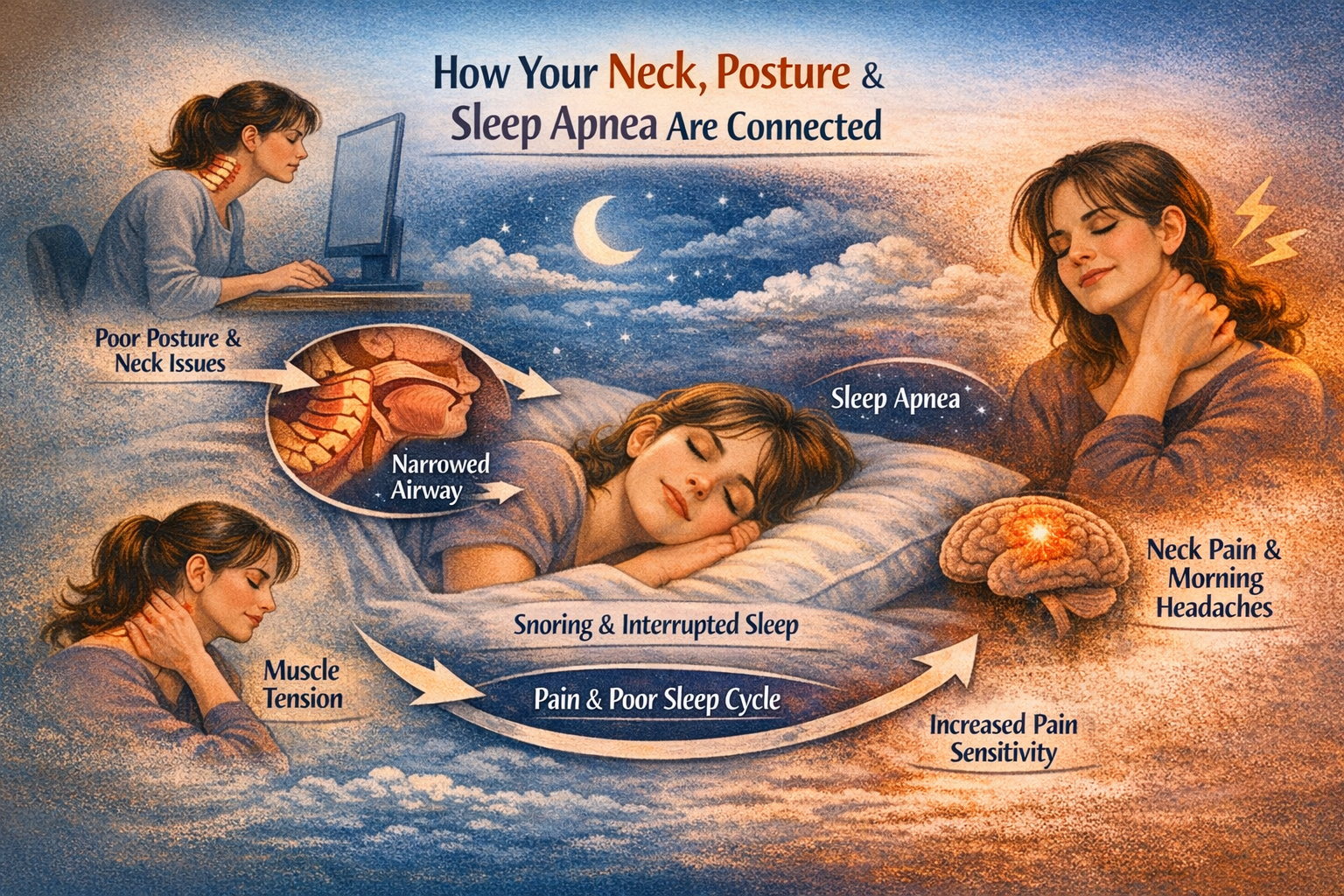
Most people think obstructive sleep apnoea is just about snoring or a blocked airway. But research is starting to show that the way your neck and posture are set up can quietly influence how well you breathe at night. If you wake up tired, your neck feels stiff in the morning, or your posture seems to affect everything from your shoulders up, you’re not imagining it — there’s real science behind that connection.¹
Let’s break it down in a way that actually makes sense.
What Sleep Apnoea Really Is?
Obstructive sleep apnoea (OSA) happens when the airway becomes too narrow or collapses during sleep. This can lead to:
Snoring.
Gasping or waking suddenly.
Restless nights, morning headaches, and that heavy, foggy feeling the next day.¹
But your airway doesn’t work in isolation. It’s surrounded and supported by the muscles, joints, and posture of your neck and upper back. When those areas are stiff, tight, or poorly aligned, they can subtly change how much space you have behind the tongue and how easily the airway collapses as your muscles relax during sleep.¹
What the Research Is Telling Us
A recent systematic review looked at how the cervical spine, posture, and neck pain are linked with sleep apnoea.¹ The findings were surprisingly consistent:
Many people with OSA also show changes in their neck posture, such as:
A forward‑carried head.
A flattened or reduced natural neck curve.
Stiffness or reduced movement in the upper cervical joints.
These aren’t just “bad posture.” They can change the tension and shape around the airway, making it easier for it to narrow or collapse during sleep.¹
Forward head posture, in particular, plays a big role. When your head drifts forward — something that happens easily with long hours on screens, driving, or desk work — the muscles under the jaw and at the front of the neck tighten. This can reduce the space behind the tongue and change the angle of the airway. It’s not a dramatic change, but when your muscles fully relax at night, it can be enough to matter.¹
The review also found that sleep apnoea and neck pain often go together. People with OSA frequently report:
A stiff, achy neck.
Tight shoulders.
Morning headaches.
Reduced neck movement.¹
Poor sleep increases pain sensitivity, and ongoing neck pain makes it harder to sleep well. It becomes a cycle that’s hard to break unless both sides are addressed.
Another important finding is that how your neck moves affects how well you breathe at night. The cervical spine helps control airway size, the tone of the muscles around the throat, and even breathing patterns. When the neck isn’t moving freely, the airway often doesn’t behave as well as it could.¹
What This Means for You
If you’re dealing with:
Snoring or pauses in breathing at night.
Poor sleep quality, morning headaches, or constant daytime fatigue.
Neck stiffness, tight shoulders, or that “forward head” posture from desk work,
your neck and airway might be influencing each other more than you realise. Understanding this connection is empowering — because it means there are things you can do to support better sleep and better movement.¹
Where Chiropractic and Exercises Fit In
Chiropractic care doesn’t “cure” sleep apnoea — that’s not what the research claims. But it does show that improving neck mobility, reducing muscle tension, and supporting healthier posture can reduce some of the factors that make sleep apnoea worse. Many people notice they:
Breathe more comfortably during sleep.
Sleep more deeply.
Wake with fewer headaches and less stiffness.
once their neck is functioning better.¹
A second study looked at modified cervical and shoulder retraction exercises in people with a flattened neck curve and neck pain.² After a few weeks of targeted exercises, participants showed:
A healthier cervical curve returning.
Less neck pain.
Better neck range of motion and overall function.²
By focusing on the deep stabilising muscles and reducing overload on the upper neck, these exercises helped improve alignment and make movement easier. It’s a clear reminder that the right exercises — done consistently — can change both how your neck feels and how it’s shaped over time.²
Putting It All Together
If you’re someone who:
Works long hours at a desk.
Drives a lot.
Or has noticed that your neck stiffness and poor sleep are getting worse together,
then your posture and neck function may be quietly feeding into your breathing and sleep quality — and the other way around.¹,²
Chiropractic care and specific exercises don’t replace CPAP or other medical treatments for sleep apnoea, but they can act as a supportive layer — helping you breathe, move, and rest more easily so your body is better equipped to heal and recover.¹,²
References
Sutherland K, Cistulli PA. Obstructive sleep apnea’s association with cervical spine abnormalities, posture, and pain: A systematic review. Sleep Med. 2020;75:231‑240. doi:10.1016/j.sleep.2020.08.041
Lee MY, Jeon H, Choi JS, Park Y, Ryu JS. Efficacy of modified cervical and shoulder retraction exercise in patients with loss of cervical lordosis and neck pain. Ann Rehabil Med. 2020;44(3):210‑217. doi:10.5535/arm.19117